
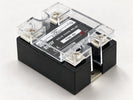
Solid State Relay (SSR) Guide: How It Works & When to Use One
, by Daniel Rehe, 14 min reading time
, by Daniel Rehe, 14 min reading time

Key Takeaways:
A solid state relay (SSR) is an electronic switch that controls an electrical load without moving contacts. A small input signal activates internal semiconductor components, which switch the output circuit on or off. Because it has no mechanical contacts, an SSR can operate quickly, quietly and repeatedly with minimal physical wear.
Need to switch a heater, light, motor or other electrical load many times each day? A mechanical relay may wear, click or produce contact arcing under frequent operation.
A solid state relay offers a different approach. This guide explains how an SSR works, where it is used, what specifications matter and how to select one safely.
A solid state relay is a switching device that uses electronic components instead of moving contacts. It performs a similar basic task to an electromechanical relay: a low-power control signal operates a separate load circuit.
The main difference is what happens inside the device. A mechanical relay uses an energised coil to move metal contacts. An SSR uses semiconductor devices, such as thyristors, TRIACs, MOSFETs or transistors, depending on whether it is designed for an AC or DC load. Many models also use optical isolation. This allows the control side and load side to communicate through light while remaining electrically separated.
Isolation helps protect low-voltage control equipment, such as a programmable logic controller or temperature controller, from the higher-voltage load circuit. The exact isolation method and rating depend on the product.
Because it has no contacts physically opening or closing, an SSR does not produce contact bounce or an operating click. It can also handle frequent switching without the same mechanical wear found in conventional relays.
A Solid State Relay works in four main stages:
Some AC models use zero-cross switching. They turn on when the AC waveform is close to zero voltage, which can reduce electrical noise and switching stress with suitable resistive loads.
Random-turn-on models respond without waiting for a zero crossing. They may be preferred for phase control or loads requiring precise switching timing.
Industrial switching systems often face practical problems that a correctly selected solid state relay can help address.
Frequent Mechanical Relay Replacement
Mechanical contacts gradually wear, particularly when switching frequently or handling loads with high inrush current. An SSR has no moving contacts, making it useful for applications with rapid or repeated on-off cycles.
Noise in the Workplace
Traditional relays make an audible click whenever their contacts move. Solid-state switching is silent, which can be useful in laboratories, commercial equipment, building controls and other noise-sensitive environments.
Slow or Inconsistent Switching
Mechanical contacts can bounce briefly when closing. This may create several rapid electrical transitions instead of one clean change. A solid state relay provides contact-free switching without mechanical bounce.
Limited Space or Control Compatibility
Low-power electronic outputs can control many SSRs. This makes them practical for PLCs, temperature controllers and automated control systems. DIN rail, panel-mount and PCB formats can also support different enclosure layouts.
An SSR does not automatically solve every switching problem. Poor load matching, inadequate cooling or missing circuit protection can still cause failure. Correct engineering and product selection remain essential.
| SSR type | Control input | Switched output | Common use |
|---|---|---|---|
| DC input, AC output | DC | AC | Heaters, lamps and suitable AC loads controlled by a PLC |
| AC input, AC output | AC | AC | AC control circuits switching AC loads |
| DC input, DC output | DC | DC | DC heaters, valves and other compatible DC loads |
| AC input, DC output | AC | DC | Applications requiring AC control of a DC load |
| Three-phase SSR | Varies | Three-phase AC | Three-phase heaters and industrial loads |
| Motor-control SSR | Varies | Motor circuit | Compatible motor switching or reversing applications |
A solid state relay is often chosen when an electrical load must be switched frequently, accurately or quietly.
Common applications include:
Load type matters as much as normal running current. Resistive heaters, incandescent lamps, transformers, solenoids and motors behave differently when switched.
| Feature | Solid State Relay | Mechanical relay |
|---|---|---|
| Moving parts | None | Uses a coil and moving contacts |
| Operating sound | Silent | Produces an audible click |
| Switching speed | Generally fast | Generally slower |
| Contact bounce | None | Can occur |
| Wear during frequent switching | Low mechanical wear | Contacts and mechanism wear over time |
| Off-state leakage current | A small current may remain | Usually negligible across open contacts |
| On-state behaviour | Has a voltage drop and produces heat | Low contact resistance when healthy |
| Electrical isolation | Common, but product-dependent | Physical contact separation provides isolation |
| Typical failure mode | May fail short-circuit | Contacts may weld, burn or fail open |
| Cooling requirements | Often needs thermal management | Usually produces less contact heat |
The main advantage of an SSR over a mechanical relay is reliable and silent operation during frequent switching. This makes it particularly useful for temperature control, where a controller may cycle a heater many times per minute.
A mechanical relay may be preferable for infrequent switching, very low-level signals, lower heat generation or applications requiring negligible leakage in the off state.
Control Input
Confirm whether the controller provides an AC or DC signal. Check that the available input voltage and current fall within the SSR’s specified input range.
Load Voltage
The output voltage rating must suit the electrical supply. It should also provide an appropriate margin for normal voltage variations and transients.
Load Current
Consider the continuous current, starting current, switching frequency, duty cycle and ambient temperature. The relay’s permitted current may decrease as the surrounding temperature rises.
Output Type
Match the SSR to an AC or DC load. An AC-output Solid State Relay is not a general replacement for a DC-output device.
Switching Method
Choose zero-cross, random-turn-on, or another control method based on the load and application.
On-State Voltage Drop
A conducting semiconductor creates a voltage drop. This produces heat inside the Solid State Relay while current is flowing.
Off-State Leakage Current
A small current may pass through an SSR even when it is switched off. This can affect sensitive, high-impedance or very low-power loads.
Isolation Rating
Check the manufacturer’s specified isolation between the control and output circuits.
Surge Capability
Confirm that the relay can tolerate the load’s expected inrush current and electrical transients.
Mounting and Protection
Review heatsink, thermal compound, fuse, enclosure, ventilation and terminal requirements.
A Solid State Relay generates heat because its output semiconductor has an on-state voltage drop or resistance.
When load current flows, the device loses some electrical power and converts it into heat. Heat generation generally increases as the current rises.
If that heat cannot move away from the Solid State Relay, its internal junction temperature may exceed its safe operating limit. This can shorten the device’s life or cause sudden failure.
Higher-current applications often require:
The required thermal design depends on the load current, duty cycle, ambient temperature, mounting position and thermal resistance values given in the datasheet.
Fastron offers pre-drilled Solid State Relay heatsinks for suitable applications.
A suitably qualified person must complete electrical installation. An SSR and its heatsink may operate at dangerous voltages, and the heatsink can become hot during normal service.
Use this seven-step process before purchasing an SSR:
For three-phase loads, verify whether the system requires two-leg or three-leg switching. You must also confirm whether the selected unit suits the load connection and control method.
If you are uncertain, provide Fastron with the control voltage, supply voltage, load type, phase arrangement, current and expected switching frequency.
A Solid-State Relay provides fast, quiet, wear-free electronic switching for many industrial and commercial applications. It is particularly valuable where a controller must switch a load frequently, such as in temperature-control and process-control equipment.
The correct choice depends on more than the current printed on the case. Input compatibility, AC or DC output, load inrush, switching method, leakage current, voltage drop, cooling and protection can all affect performance.
If your application needs dependable and repetitive switching, explore Fastron’s range of solid state relays. The collection includes products for different control signals, output types, mounting arrangements and load requirements.
A Solid State Relay switches an electrical load from a separate control signal without moving contacts. Common uses include heaters, temperature-control equipment, lighting, valves and compatible motors. Select the SSR for the control voltage, load voltage, current, inrush demand, and AC or DC output type.
An SSR is often better for rapid, frequent or silent switching because it has no moving contacts or contact bounce. A mechanical relay may be better for infrequent operation, low off-state leakage or applications requiring physical contact separation. Neither option is best for every circuit.
The main advantage is its ability to complete many switching cycles without mechanical contact wear. A solid state relay also operates silently and switches without contact bounce. These characteristics suit repetitive industrial control, although you still need to manage heat dissipation and leakage current.
Depending on its design, an SSR can switch resistive heaters, lamps, solenoids, transformers, contactor coils and certain motors. These loads have different inrush and switching characteristics. A relay suitable for a heater may not suit a motor with the same running current.
Solid State Relays generate heat because the semiconductor output has a voltage drop or resistance while conducting current. This creates internal power loss. Many applications require a heatsink, thermal interface material and suitable airflow. Always check the manufacturer’s thermal curves and derating information.
Leakage current is the small amount of current that can flow through the output of a Solid State Relay while it is switched off. It occurs because of the semiconductor circuit and protective components. It may cause sensitive loads, indicator lamps or high-impedance equipment to remain partly energised.
Choosing the wrong SSR can cause overheating, unreliable switching or early failure. Fastron Electronics supplies Solid State Relays, heatsinks, assemblies, fuses and related power-control components for Australian applications.
Explore Fastron’s Solid State Relay range or talk to the Fastron team about your load type, voltage, current, control signal and switching frequency.


