
Digital-Mustimeters: How to Choose the Right One for Electrical Work
, by Daniel Rehe, 15 min reading time
, by Daniel Rehe, 15 min reading time

Key Takeaways:
A digital multimeter combines several electrical measuring functions in one portable instrument. At a minimum, most models measure voltage, resistance and current. Many also test continuity and diodes, while professional models may measure capacitance, frequency, temperature, duty cycle or minimum and maximum values.
The word “digital” refers to the electronic display. Unlike an analogue meter with a moving pointer, a digital model converts the measurement into a numerical reading. This makes the result easier to read and can provide greater resolution.
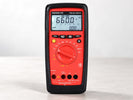
A typical digital multimeter has a display, rotary function selector, input terminals and removable test leads. Internal protection may include fuses, resistors and other components designed to limit damage from overloads or incorrect connections. Protection levels vary, so appearance alone cannot tell you whether a meter suits switchboards, industrial equipment, or high-energy circuits.
Only trained and authorised people should test live electrical installations. Always follow the instrument manufacturer’s instructions and applicable Australian electrical safety procedures.
A suitable digital multimeter helps turn an electrical fault into a measurable problem. Depending on the circuit and the user’s qualifications, it may help identify:
For example, a continuity test can help confirm whether a disconnected conductor provides an unbroken path. A voltage measurement can show whether power reaches a particular point. Resistance testing can help compare a component against an expected value when the circuit is safely isolated.
The instrument provides information, not a diagnosis. The technician must select the correct function, connect the leads properly and interpret the reading within the circuit’s design.
Functions vary between models, but common measurements include:
| Function | What it measures | Typical purpose |
|---|---|---|
| AC voltage | Alternating voltage | Checking compatible mains and equipment circuits |
| DC voltage | Direct voltage | Testing batteries, power supplies and control circuits |
| AC/DC | Current flowing through a circuit | Investigating load or circuit operation |
| Resistance | Opposition to current flow | Checking components and isolated circuits |
| Continuity | Whether a low-resistance path exists | Finding open wires, switches or fuses |
| Diode test | Semiconductor forward-voltage behaviour | Performing basic diode and semiconductor checks |
| Capacitance | Electrical charge-storage value | Testing compatible capacitors |
| Frequency | Signal cycles per second | Checking AC supplies and control signals |
| Temperature | Temperature through a compatible probe | HVAC and process troubleshooting |
Never assume every digital multimeter supports every function or range shown above. Check the product specifications and confirm that the supplied or optional accessories suit the intended measurement.
A meter that is ideal for basic electronics may not have the safety rating required for fixed electrical installations. Similarly, an electrician’s meter may lack the detailed resolution needed for low-voltage electronic work.
Use this numbered decision checklist before buying a Digital Multimeter.
1. Identify the Electrical Work You Will Perform
Start with the application. Electronics work, automotive testing, appliance repair, commercial installations and industrial maintenance involve different voltages, transient risks and testing functions.
List the circuits you will test and whether they are AC or DC. You should also identify the measurements you perform most often. This prevents you from paying for unused features or buying a meter that cannot safely handle the work.
2. Choose the Correct CAT Safety Rating
The measurement category describes the transient energy environment, not simply the circuit’s normal voltage.
Broadly:
Choose a Digital Multimeter with a category and voltage rating appropriate for the highest-energy environment in which it will be used. A higher voltage number in a lower category does not automatically make a meter safer for a higher-category environment. For example, you should not assume a CAT II 1,000 V meter is suitable for CAT III 600 V work. Always consider the category and voltage rating together.
3. Confirm the Required AC and DC Ranges
Check the highest and lowest values you need to measure.
The Digital Multimeter must support the expected AC and DC voltage ranges without exceeding its limits.
Using a meter outside its rated range can damage the instrument and expose the user to electrical hazards. You should also consider the required current range.
Measuring current with a standard multimeter normally requires opening the circuit and connecting the instrument in series. For higher currents, a suitable clamp meter may be safer and more practical than passing the current directly through a handheld meter.
4. Decide Whether You Need True RMS
A True RMS digital multimeter can provide more accurate AC readings on non-sinusoidal waveforms, provided the signal remains within the instrument’s bandwidth and crest-factor limits.
Distorted waveforms are common around:
An average-responding meter may be adequate for measuring clean sine waves. For modern industrial and commercial electrical work, however, True RMS is often the more useful choice.
5. Check the Core Measurement Functions
Confirm that the digital multimeter measures the values you actually need.
For general electrical troubleshooting, this may include:
Electronics work may require capacitance, diode testing, frequency and greater resolution. HVAC technicians may benefit from temperature measurement and microamp capability. Automotive technicians may require duty cycle, frequency or min/max recording. Choose functions based on regular tasks rather than occasional possibilities.
6. Compare Accuracy, Resolution and Display Counts
Accuracy indicates how close the displayed reading is expected to be to the actual value under stated conditions. It is usually written as a percentage of the reading plus a number of counts.
For example, an accuracy specification may appear as:
±(0.5% of reading + 2 counts)
Resolution is the smallest change that the digital multimeter can display.
Display count describes how many values the screen can represent before the meter changes to another range. Common examples include 2,000-count, 4,000-count and 6,000-count displays. More digits do not automatically mean greater accuracy. Always compare the complete accuracy specification rather than judging the meter by display count alone.
7. Review Input Protection and Internal Fuses
Input protection is one of the most important digital multimeter features.
Look for:
Test leads, probes, and accessories must also have suitable voltage and CAT ratings.
8. Choose Auto-Ranging or Manual Ranging
An auto-ranging digital multimeter selects an appropriate range automatically. This makes it convenienautomatically selects an appropriate ranget for general troubleshooting when the expected value is unknown.
Manual ranging gives the user direct control. It may be useful when monitoring a changing value, comparing repeated readings or working with a known range.
Many professional meters include both options.
Auto-ranging is often easier for beginners, but it does not remove the need to select the correct measurement function and connect the leads properly.
9. Add Specialist Features Only When Useful
Optional digital multimeter features may include:
Choose features that support real work.
A long list of additional functions cannot compensate for an unsuitable CAT rating, poor input protection or inadequate measurement range.
10. Check Durability, Calibration and Support
For daily field work, consider how the digital multimeter will handle transport, dust, moisture, accidental drops and regular use.
Review:
A cheaper meter may cost more over time if it cannot withstand the working environment or maintain dependable measurement performance.
| Category | General environment | Examples |
|---|---|---|
| CAT II | Loads connected to socket outlets | Appliances and portable electrical tools |
| CAT III | Distribution and fixed installations | Distribution boards, fixed wiring and industrial equipment |
| CAT IV | Source of the low-voltage installation | Service entrances, utility connections and outdoor supply conductors |
These descriptions are general. Always refer to the Digital Multimeter manufacturer’s instructions and applicable standards for the exact testing environment.
A CAT III 600 V rating and a CAT III 1,000 V rating are not equivalent. Assess category and voltage together.
Never use a digital multimeter above its marked category or voltage limits. The meter, test leads, probes and accessories must all be suitably rated.
True RMS describes how a digital multimeter calculates the effective value of an AC waveform.
A basic average-responding meter can provide a useful result when the waveform is a clean sine wave. Its reading may become inaccurate when the waveform is distorted.
A True RMS Digital Multimeter is valuable when testing:
True RMS does not mean the meter is accurate in every situation.
Check the model’s specifications:
A signal outside these limits may still produce an unreliable reading.
| Consideration | Basic meter | Professional electrician’s meter | Specialist industrial meter |
|---|---|---|---|
| Typical use | Low-energy general checks | Commercial and fixed-installation troubleshooting | Industrial systems and detailed diagnostics |
| CAT rating | Product-dependent | Often CAT III or CAT IV, depending on the model | Selected for specific high-energy environments |
| True RMS | May not be included | Common | Common, with defined bandwidth limits |
| Core functions | Voltage, resistance and current | Core functions plus practical field tools | Advanced capture, logging or specialist measurements |
| Accuracy | Suitable for general checks | Higher accuracy for regular troubleshooting | Selected for demanding measurement requirements |
| Durability | Light or occasional use | Designed for regular field use | Often ruggedised for demanding environments |
| Best suited to | Hobbyists or controlled low-energy work | Licensed electricians and service technicians | Industrial technicians and engineers |
Choosing by Price Alone
Price matters, but safety rating, input protection and suitability matter more.
Don't use a low-cost digital multimeter designed for electronics on a commercial switchboard.
Looking Only at Maximum Voltage
The CAT category and voltage rating work together. A CAT II meter with a high maximum voltage is not automatically suitable for CAT III or CAT IV work.
Ignoring the Test Leads
Damaged, poorly insulated or incorrectly rated leads can make an otherwise suitable meter unsafe. Inspect leads before use and replace damaged items with manufacturer-approved or appropriately rated alternatives.
Assuming True RMS Solves Everything
True RMS improves the measurement of distorted AC waveforms, but accuracy still depends on frequency, crest factor, measurement range and correct operation.
Buying Features You Will Never Use
Advanced functions can be valuable, but they also increase cost and complexity. Prioritise safety rating, input protection, measurement range and accuracy before optional tools such as Bluetooth connectivity or data logging.
Measuring Current Through the Wrong Terminal
Leaving a test lead in the current terminal and then attempting a voltage measurement can create a dangerous short circuit.
Always check the lead position, selected function and circuit conditions before taking a measurement.
The right digital multimeter is not necessarily the model with the most functions. It is the meter that safely matches your working environment and performs the measurements you need with suitable accuracy.
Start with the CAT safety rating. Then check the AC/DC ranges, True RMS capability, core functions, input protection, accuracy and durability.
Treat specialist features as the final part of your decision, not the first.
Fastron supplies electrical measurement and testing equipment for Australian industrial, commercial and technical applications.
Explore the Fastron multimeter range to compare available models and specifications.
A digital multimeter measures electrical values such as AC/DC voltage, current and resistance. Many models also test continuity, diodes, capacitance and frequency. Electricians and technicians use them to confirm supply conditions, test components and investigate faults. The user must select a meter rated for the circuit and testing environment.
The required CAT rating depends on where the measurement occurs. CAT II generally covers outlet-connected loads, CAT III covers distribution and fixed-installation circuits, and CAT IV applies near the installation source. Match both the category and voltage rating to the work, including the test leads and accessories.
A True RMS meter is recommended when measuring AC circuits with distorted or non-sinusoidal waveforms, including variable speed drives, electronic lighting and switch-mode power supplies. An average-responding meter may suit clean sine waves. Always check the True RMS meter’s bandwidth, range and accuracy limits.
Auto-ranging is convenient because the digital multimeter automatically chooses a suitable range. Manual ranging provides more control and may help when monitoring a known or changing value. Neither option is always better. Many professional meters include both modes, allowing users to choose the most practical setting.
A multimeter uses test leads for voltage, resistance and other measurements. It normally measures current by being connected in series with the circuit. A clamp meter measures current by clamping around a conductor without opening the circuit. Many clamp meters also include standard multimeter functions, although specifications and accuracy vary.
Need help comparing CAT ratings, measurement ranges or True RMS functions?
Explore Fastron’s multimeters or talk to the Fastron team about the electrical work and measurements your instrument needs to support.


